
Menu
Working with kids affected by complex trauma—whether intergenerational, attachment-based, or vicarious— can be difficult, especially when their caregivers are coping with traumas of their own.
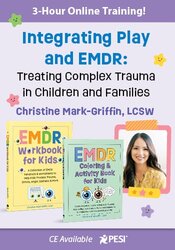
Watch Christine Mark-Griffin, LCSW, EMDRIA-Approved Consultant, for this dynamic 3-hour recording on how to use EMDR therapy to help both children and their grownups heal from complex trauma…together.
In this training, Christine offers practical techniques, insightful guidance, and case examples as she walks you through how to:
This training is not affiliated with EMDRIA and does not qualify towards EMDRIA credits or training.

Christine Mark-Griffin, LCSW, RPT, RYT, is an internationally recognized trainer, author of the award-winning EMDR Workbook for Kids, and Founder of Spark All Wellness and EMDR for Kids. She is the Lead Trainer for Transcending Trauma Through Yoga, an EMDR Institute and EMDR Humanitarian Assistance Programs (EMDRHAP) Facilitator, and an EMDRIA Approved Consultant specializing in Attachment-Focused EMDR, play therapy, and trauma-informed yoga. Christine provides EMDR therapy for children and families, consultation for clinicians, and trauma-informed trainings for organizations worldwide.
Speaker Disclosures:
Financial: Christine Mark-Griffin is the founder of EMDR for Kids and Spark All Wellness and has employment relationships with Transcending Trauma Through Yoga, California State University. She is an affiliate partner with Bumble BLS, Wevana, and Bilateralstimulation.io. Christine Mark-Griffin receives a speaking honorarium, recording and book royalties from PESI, Inc. All relevant financial relationships with ineligible organizations have been mitigated.
Non-financial: Christine Mark-Griffin is a member of National Association of Social Workers (NASW) and EMDR International Association (EMDRIA).
Visit our FAQ page at www.pesi.com/faq or contact us at www.pesi.com/info
Getting Started: EMDR-Focused Assessment and Treatment Planning
Case conceptualization through the lens of EMDR
Utilizing the Adaptive Information Processing (AIP) Model
Child Friendly 3 prong approach
How to bring playfulness into clinical assessment
Strategies for learning the family’s trauma narrative
Identifying target memories for kids and their caregivers
Interventions: Playful assessments, sentence completions, Turtle of Tolerance
Resourcing: Play-Based Interventions to Build Support and Enhance Resilience
The importance of resourcing in EMDR – and why play enhances its efficacy
Bilateral-inspired games and activities
Using creative arts to reimagine trauma stories
Repairing attachment and ruptures through play
Puppets, sandtray, dollhouses, toys, building blocks, and more
Interventions: Rescue Play, Building & Rebuilding, Attachment Resource Development & RDI
Reprocessing Complex Trauma: Playful EMDR Strategies for Children and Their Grown-ups
Assessing child and grown up readiness for conjoint sessions
Playing the “EMDR” game with kids & grown ups
Modifying standard EMDR protocol to be developmentally appropriate
Co-regulation techniques for the caregiver
Interventions: Story Telling Technique, Reprocessing Together, Future Templates
Develop trauma-informed case conceptualizations using Adaptive Information Processing Theory for children experiencing complex trauma
Utilize play-based and EMDR strategies with children and their caregivers during conjoint EMDR therapy sessions.
Summarize how EMDR and play interventions can be combined to enhance healing complex trauma in children
Please wait ...