

Not Found
Digital Seminar

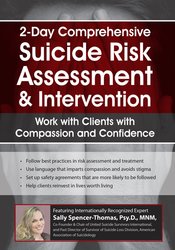
2-Day Comprehensive Suicide Risk Assessment & Intervention: Work with Clients with Compassion and Confidence


Faculty:
Sally Spencer-Thomas, PsyD
Duration:
12 Hours 41 Minutes
Copyright:
18 Dec, 2019
Product Code:
POS055580
Media Type:
Digital Seminar
Access:
Never expires.


Description

The epidemic of suicide continues to wreak havoc in the lives of millions of Americans.

With suicide rates on the rise, the need is urgent for clinicians who can recognize warning signs earlier, intervene with current and proven strategies, and even inoculate clients against the chance of suicidal thoughts emerging in the future. It’s a daunting challenge that has undoubtedly left you feeling confused, overwhelmed, and even scared.

Don’t let fear push you away.

This recording will transform how you view and work with suicidal clients and give you the clinical tools you need to save lives. Over the course of the program, you will dive deeply into a comprehensive approach to suicide risk assessment and intervention. You will gain confidence and a heightened sense of compassion that are essential to understanding where clients are on their life journeys and how you can instil hope and a renewed desire to invest in lives that are worth living.

Finish this recording feeling confident and capable to work with suicidal clients and guide them out of the darkness and back into the light!

CPD


CPD
- PESI Australia, in collaboration with PESI in the USA, offers quality online continuing professional development events from the leaders in the field at a standard recognized by professional associations including psychology, social work, occupational therapy, alcohol and drug professionals, counselling and psychotherapy. On completion of the training, a Professional Development Certificate is issued after the individual has answered and submitted a quiz and course evaluation. This online program is worth 12.75 hours CPD for points calculation by your association.

Handouts

Faculty

Sally Spencer-Thomas, PsyD's Profile

Sally Spencer-Thomas, PsyD Related seminars and products


Sally Spencer-Thomas, PsyD is a clinical psychologist, award-winning keynote speaker, and impact entrepreneur dedicated to transforming suicide prevention from risk management to meaningful healing. She is internationally recognized for integrating the stories, science, and strategy of suicide prevention to help clinicians, leaders, and organizations move beyond liability-driven care toward compassionate competence. 
 

Dr. Spencer-Thomas is Co-Founder and President of United Suicide Survivors International and co-founder of Man Therapy®, an innovative men’s mental health initiative. She served as the founding Executive Secretary of the National Action Alliance for Suicide Prevention and has held national leadership roles with the American Association of Suicidology (AAS), including Executive Board Member and Secretary, as well as leadership positions within the International Association for Suicide Prevention (IASP). She has served on Lived Experience Advisory Committees for the Suicide Prevention Resource Center and the National Suicide Prevention Lifeline (now 988), helping embed lived experience into national strategy. 
 

A TEDx speaker and White House invitee, Dr. Spencer-Thomas has consulted and presented across North America, Europe, Asia, and Australia. Her most important credential, however, is her lived experience as a suicide loss survivor—a calling that drives her work to help clinicians not only prevent suicide but sustain a passion for living in the people they serve. 


Speaker Disclosures:
Financial: Sally Spencer Thomas maintains a private practice and receives royalties as a published author. She receives a speaking honorarium and recording royalties from Psychotherapy Networker and PESI, Inc. She has no relevant financial relationships with ineligible organizations.
Non-financial: Sally Spencer Thomas is the president of United Suicide Survivors International and is a member of the executive board for the American Association of Suicidology. She is co-chair of the Workplace Special Interest Group for the International Association of Suicide Prevention and is a member of the Suicide Prevention Lifeline.


Objectives

  1. Describe how to overcome fear and personal bias when working with suicidal clients.
  2. Examine the latest hot topics in suicidology and their impact on improved assessment and intervention efforts.
  3. Determine the appropriate circumstances for applying upstream, midstream, and downstream approaches to suicide prevention.
  4. Explain how to implement earlier identification and triage as valuable components of comprehensive risk assessment and intervention.
  5. Choose language that imparts compassion and avoids stigma for use in all stages of work with suicidal clients.
  6. Contrast various suicide assessment tools to better inform clinical decision-making.
  7. Ascertain key indicators of imminent suicide and develop a strategy for determining when and how to hospitalize clients.
  8. Reduce access to lethal means by implementing a multi-systemic approach that incorporates the suicidal person’s social connections into their safety plan.
  9. Articulate the “stop, drop, and roll” of suicide prevention effectively to clients so that it can be accessed in crisis situations.
  10. Employ a collaborative safety approach to help clients survive a suicidal crisis while avoiding the pitfalls of suicide contracting.
  11. Utilize measurements of post-traumatic growth to assess clients’ progress in adapting more healthy response mechanisms.
  12. Make sense of the unique nature of suicide grief to improve the clinical options offered in response to it.

Outline

OVERCOME BIAS AND FEAR

Prepare to do suicide work with compassion and confidence

  • Self-Reflection: Time to unpack our own baggage
  • Countertransference
  • Our own history with suicide

HOT TOPICS IN SUICIDOLOGY

Evaluate the latest developments and their impact on assessment and intervention

  • The latest data, and what to do with it
  • Mental health and suicide
  • Alcohol and suicide
  • Opioids and suicide
  • Additional forms of trauma and suicide
  • Aspiring to Zero Suicide
  • Why “Means Matter”
  • Understanding the many forms of the suicidal mind
  • Soul exhaustion

COMPREHENSIVE APPROACH TO SUICIDE RISK ASSESSMENT & TREATMENT

Determine where to enter the prevention stream, and how to navigate successfully

  • Upstream, midstream, and downstream approaches
  • Build resilience and crisis inoculation
  • Earlier identification and triage
  • Trauma-informed care
  • Learn from the experiences of suicide attempt and loss survivors

RISK ASSESSMENT

Elicit key information from clients

  • The many paths to suicide
  • Communicate caring: Language to impart compassion and avoid stigma
  • Suicide risk assessment
    • SAFE-T
    • IS PATH WARM
    • Ideation, plan, means, intent
    • Level of risk
  • Standardized assessment tools to augment clinical judgment
  • Obtaining collateral information
  • Types of questions to uncover suicidal ideation
    • What if they say “No”?
    • What if they say “Yes”?
  • Behaviour chain analysis
  • Why “No Suicide” contracts are dead
  • Best practices in risk assessment

COLLABORATIVE SAFETY AGREEMENTS AND WELLNESS PLANNING

Help clients regulate emotions and feel safe, valued and connected

  • Set up a safety agreement that is more likely to be followed
  • Reduce access to lethal means (C.A.L.M.)
  • The “Stop, Drop, and Roll” of suicide safety planning
  • Treatment strategies built on preserving choice and dignity
    • Cognitive Behavioral Therapy
    • Dialectical Behavior Therapy
    • Relapse prevention plans
    • When and how to hospitalize

MAKING MEANING

Help clients reinvest in a life worth living

  • The PIE of life – brainstorm possibilities of growth
  • Narrative psychology and the power of storytelling
  • Cultivate social connection and re-engagement
  • Choice and perspective
  • Foster gratitude and a spirit of contentment after loss
  • Measurements of post-traumatic growth

SAFE AND EFFECTIVE SUICIDE GRIEF & TRAUMA RESPONSE

Implement suicide grief and trauma support

  • Understand the unique nature of suicide grief
  • Peer-based support: Connect clients to other survivors of loss
  • Access and reclaim compassion

Target Audience

  • Social Workers
  • Psychologists
  • Psychiatrists
  • Counselors
  • Marriage and Family Therapists
  • Case Managers
  • Addiction Counselors
  • Therapists
  • Nurses
  • Other Mental Health Professionals
  • School-Based Counselors
  • School-Based Psychologists
  • School-Based Social Workers
  • School Administrators

Please wait ...

Back to Top